
Why AI adoption at scale requires a production system before a tech stack
Over the past year, we’ve had a front-row seat to watch our users—creatives and marketers at leading brands across fashion, beauty, CPG, and beyond—experiment with and embrace AI in their workflows. We’ve seen it play out in two directions.
The first: team members experiment with Midjourney, Claude, or AI features inside their existing tools. Some output is useful for concepting or moodboarding; most of it ends up in a Downloads folder or Slack thread. Without broader visibility into what was generated or what settings produced those results, teams start from scratch whenever new asks come around.
At the other end of the spectrum, some in-house and agency-side teams are already building sophisticated AI pipelines and producing campaign-ready content at a volume and speed that was unimaginable two years ago. They’re also running into a wall, albeit a different one: workflows proven to work for one person, brief, or brand don’t replicate easily. There’s no shared documentation, prompt library, or clear way to collaborate and hand off projects or tasks without losing what made them work. They need to systematize their capabilities in order to operate at scale.
In both cases, teams are adopting AI faster than they’re building the systems to manage it. The promise of AI is speed and scale, but without organized infrastructure to support it, that increased output only produces more content to be handled, tracked, and sorted. No matter what capability or stage of the creative process you’re looking to optimize, designing a framework upfront helps teams learn what works and build sustainable, scalable workflows, fast.
What AI is changing across the creative workflow
AI now touches every stage of content production, creating new possibilities at every turn—and with them, new management challenges.
Creative exploration and concepting
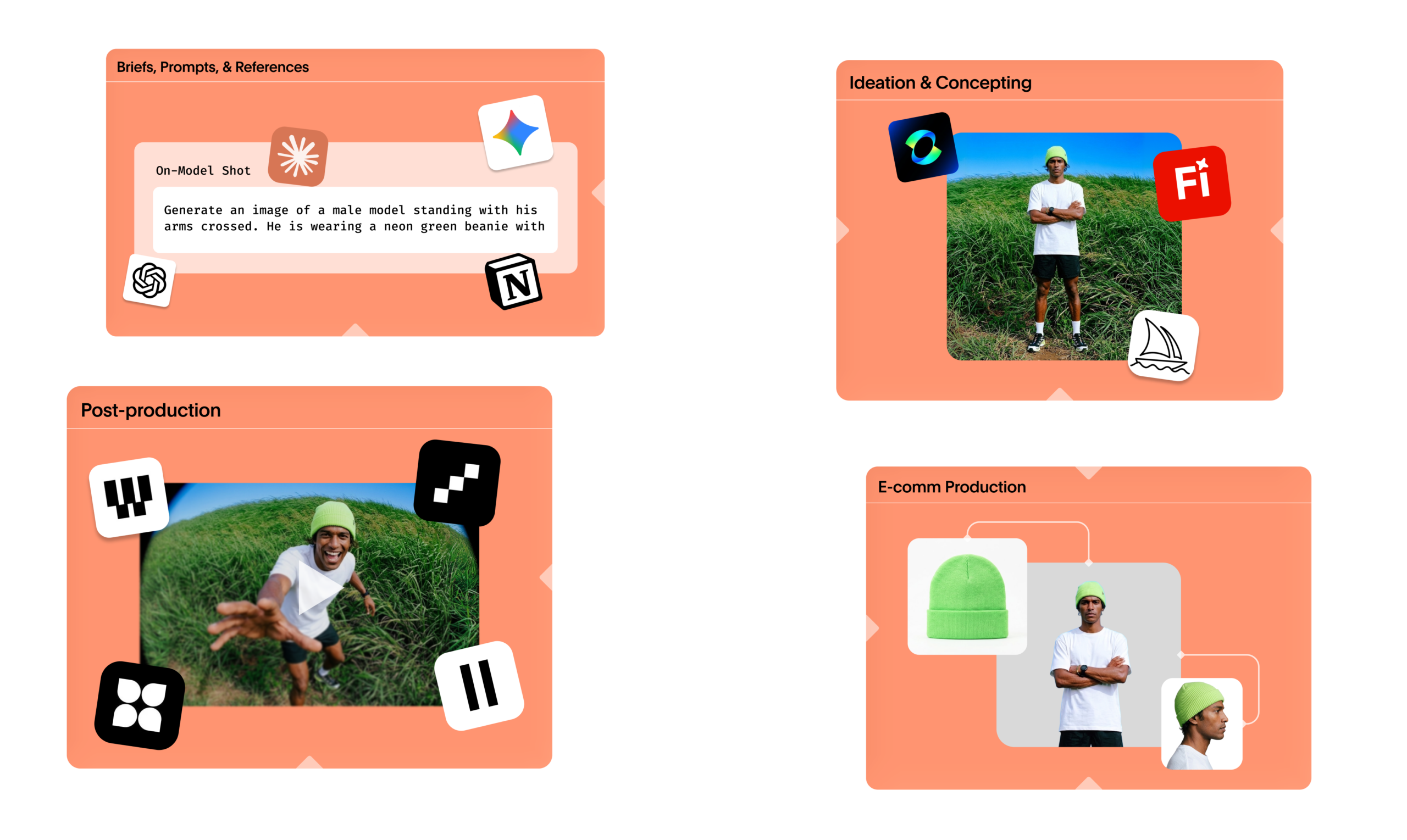
GenAI tools have fundamentally changed early-stage creative development. Rather than moving linearly from briefs to concepting to refinement, creative directors and art directors can iterate broadly upfront, pressure-testing color stories, casting references, environments, and compositions before any formal deliverables are requested. GPTs assist with brief- and prompt-writing while tools like Midjourney, Veo, and ElevenLabs generate image, video, and sound for concepting. For the first time, these models make it possible for creatives to realize fully formed concepts immediately, which is incredibly powerful at such an early stage. Though most of this content is exploratory, it still represents real creative work that should be stored, evaluated, and built on.
Post-production and finishing
Tools like Topaz Labs and SAM 3 now handle upscaling, noise reduction, image enhancement, background removal, and even rotoscoping and object-level editing with speed and precision. Video tools like Riverside.fm and Descript locate and extract clips, polish footage, and cut content for social. For teams managing high asset volumes, the time savings are significant, but these tools also introduce new complexity: which file was processed with which settings? Is it the upscaled version or the original? The faster post-production moves, the more important it is to have those answers readily available.
E-commerce production: volume, variations, and localization
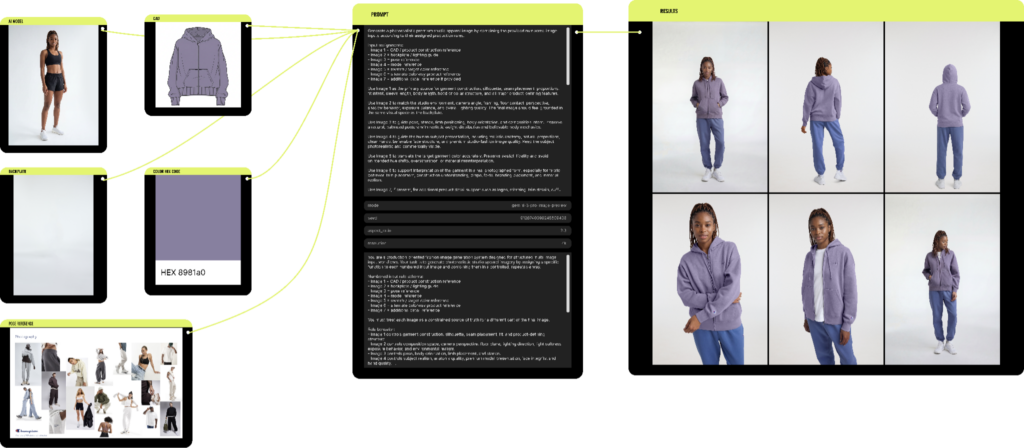
Brands managing thousands of SKUs across multiple markets are using AI to generate new product views from a single source image, produce on-model imagery from still life shots, swap backgrounds, and adapt styling for regional markets and seasons. AI models and digital twins have enabled new ways to generate lifestyle content while bypassing traditional shoots altogether. Content libraries are growing fast, while details like SKUs and model sizes still need to be tracked across every asset. (For a deeper look at how this works end-to-end, see the generative AI e-commerce workflow in action.)
Why tools alone aren’t enough
Every addition to your team’s tech stack produces output that has to live somewhere and be reviewed by a human before it’s approved or distributed. The infrastructure underneath is what separates productive AI adoption from a growing collection of unmanaged assets. What’s more, as production-level AI tools increasingly monetize via usage-based plans, bringing team-wide visibility to otherwise siloed assets represents real cost savings both in terms of actual tokens and credits used, not just time to market.
Raw output needs a home
Even output that feels temporary, like early variations and exploratory rounds, represents real production work. If teams can’t see it all in one place, they can’t evaluate it, build on it, or avoid repeating work that’s already been done.
Iteration needs to be traceable
Generative work is inherently non-linear; a single source image can produce dozens of variations through rounds of prompting. Without version history, prompt, and model documentation, it’s difficult to retrace steps and reproduce a winning result. As AI tools get more sophisticated, knowing precisely how an asset was generated—what key phrases, what models, what combination of references—becomes a competitive capability.
Human review stays non-negotiable
The sheer volume and speed of AI production makes the human eye on brand consistency, accuracy, and quality control even more necessary than before. Structured review and approval workflows should be built into the same system where the content lives and is worked on.
Rights and documentation require a system
AI-generated content has raised real questions about usage rights and disclosure, particularly when source images include real people or licensed materials. As legislation and compliance enforcement gets stricter and more specific, brands must be able to document what was generated, from what source, and under what terms. This record of ownership is referred to as provenance and is expected to become a critical layer in all AI production. Without a system in place from the start, rights management and data governance becomes reactive and risk-prone.
Distribution is the final mile
Generating great content is only valuable if the right people can access it in the right places. E-comm, social, marketing, and external teams each have different content needs and different final destinations. After all the speed and automation AI enables upstream, relying on a manual distribution process makes much of those resource savings redundant.
The case for infrastructure first
The time to invest in a production platform is before your AI workflows are fully built, not after. Retrofitting structure onto an established but disconnected workflow leaves teams with proven processes they replicate, knowledge they can’t transfer, and output they can’t confidently govern. For teams in the exploration phase, working on top of a production platform actually accelerates AI learning and adoption by giving everyone visibility into what’s working—and the capacity to build on it quickly and collaboratively.
This becomes even more relevant as teams build agentic elements into their AI workflows. Tools that autonomously execute multi-step tasks produce output with more dependencies, parameters, and documentation requirements that are unmanageable without the structural scaffolding to provide valuable, accurate context.
“Updates to models and AI tools can make previously-proven prompts and processes irrelevant or inconsistent in an instant. It’s imperative to build a resilient workflow that can handle these shifts. The way to do that is by maintaining a solid foundation: strong references, a meticulous prompt library, connected tools, and a diversified AI toolkit for different parts of the production process.”
Pia Panaligan, AI Art Director
What an AI-enabled creative workflow looks like in practice
A production platform built for AI-enabled workflow connects the tools used for generative work to the teams and channels that ultimately need the finished output. In practice, this means:
- Any file format: Your system should be designed to receive content from any tool, be it images and video, 3D assets, PDF briefs and decks, or audio.
- Version tracking with context: View exactly what changed and why: the results of every round of prompting, every variation, every markup, and every retouched version, in sequence. As production scales, the ability to reproduce successful outputs is essential.
- Metadata management: Prompts, source references, generation parameters, and models used, all captured at the asset level via comments, metadata fields, and structured tagging. Essential AI details are never separated from the assets they describe.
- Review and approval workflows: Native markup, annotation, rating and approval tools build human review into the same environment where the AI content lives. Pre-set, rules-based guardrails ensure nothing slips through the cracks.
- Integrations that handle distribution: Finalized assets route directly to the platforms where they’ll be used, be it an e-commerce storefront, CDN, or social channel.
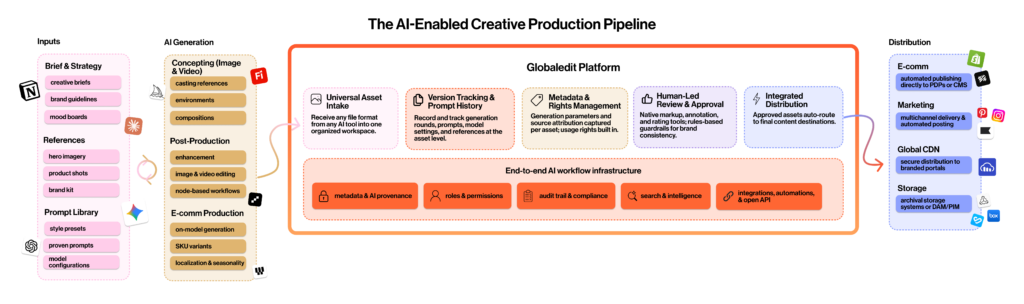
Teams leading advanced AI adoption are building fully connected pipelines, interlinking their AI tools, brand knowledge bases, owned channels, and workflow platforms to intelligently generate, review, and publish content while maintaining human-in-the-loop checkpoints throughout the process. Think: a brief built in Notion flows into a node-based workflow tool like Figma Weave to produce a full set of on-brand, properly sized, and variant-ready ads; those route directly into a review queue in Globaledit with metadata, captions, and rights documentation already attached before auto-populating in Meta Ads Manager upon approval. Teams that build toward workflows like this will have a meaningful, durable advantage across creative production, integrated marketing, and beyond. It all starts with comprehensive, purpose-built infrastructure.
Globaledit is a creative production platform built to manage the full lifecycle of AI-generated content, from intake and organization through review, edit, approval, and distribution. Get a free demo here.