
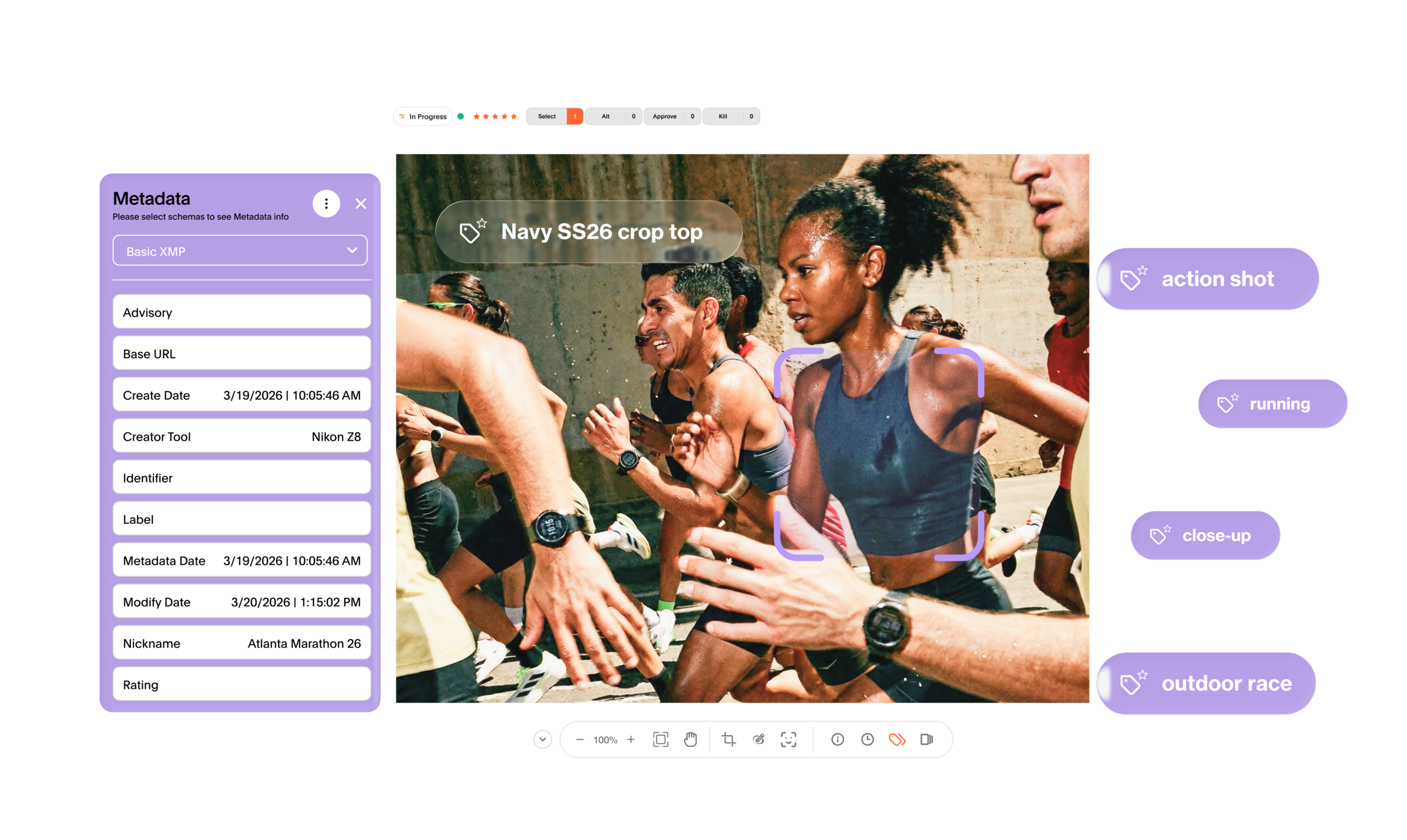
The importance of metadata management is not new in the world of content production. But as creative possibilities, tools, and workflows emerge and evolve, the case for tagging your assets goes well beyond just keeping your DAM organized. The explosion of generative AI, agentic workflows, and cross-channel content demands has fundamentally changed the role that metadata plays in creative production. Now, it provides the contextual infrastructure that intelligent, connected, AI-enabled systems need to work to their highest potential.
Let’s explore why metadata matters now more than ever, and what a modern approach to leveraging it looks like in practice.
Back to basics
Metadata is, at its core, data about data. For creative assets, it typically falls into three categories:
- Descriptive: provides basic identification information like what a file is, who created it, and what’s in it. Think: product names, photographer credits, keywords, campaign tags. This is what makes assets findable and contextually meaningful.
- Structural: identifies technical information like file format, resolution, dimensions, duration, and color profile. It tells systems how an asset is built and where it can be used.
- Administrative: governs usage, like licensing terms, rights expiration dates, model release status, and more. This is increasingly non-negotiable as regulatory and contractual complexity grows.
While these categories have always existed, the scale at which teams now need to manage them is unprecedented and rapidly growing, as is the toolkit required to do it intelligently.
Why metadata matters more in the age of AI
Organization and search
The most immediate value of strong metadata management is discoverability; granular, holistic metadata enables granular, holistic search. Given the sheer volume of content that generative AI produces compared to traditional production, good metadata is even more critical. When a single genAI exploration or campaign brief can produce hundreds of image variations, you need a systematic way to tag, sort, and retrieve them. Instead of scrolling through hundreds of product shots or scrubbing through a video, teams can filter by photographer, shoot date, model name, colorway, or campaign and get exactly what they need in seconds. And the richer the metadata attached to an asset, the more precisely AI tools like natural language search can act on it: “All images shot between January and February 2026 by Eric Diaz featuring Chiara Wise” is a query that only works if that information is captured and stored from the get-go.
A well-tagged asset library is easier to navigate, but more importantly, it offers a competitive and resource-saving edge: teams that can instantly surface the right asset in the right format with up-to-date usage rights can ship faster, avoid re-shoots, and repurpose content. If you can’t find it, you certainly can’t use it.
Collaboration
Beyond keeping up with content demands, one near-universal challenge for brands and studios regardless of size or industry is that teams lack actionable context to their company’s institutional knowledge. Often, insight into past shoots, campaigns, and workflow processes lives across old decks and spreadsheets, Slack threads, and folders that only one person knows how to navigate. Standardizing metadata across an entire asset library provides structured context—who shot it, what campaign it was for, what rights it carries—to anyone on the team. This documentation becomes even more important for teams working with generative AI, where metadata can track which tool produced a given asset, what prompts were used, what products or brand elements were referenced, and whether the output has been cleared for use. With this layer, new and external team members can onboard faster, pick up projects without compromising brand consistency, and collaborate without chasing down context from upstream stakeholders.
Rights management + compliance
The emergence of AI-generated content and evolving regulations around data usage have raised the stakes when it comes to licensing and usage rights. Metadata enables brands to enforce their own policies at scale. Expiration dates on licensed assets, AI training opt-out flags, and territorial usage restrictions can all be embedded directly in asset metadata and surfaced to creative, marketing, and PR teams at the point of use, rather than after the fact. As legislation gets more complex around publicity, consent, and AI disclosure, proactive metadata management is one of the most practical layers of protection a team can put in place.
Delivery
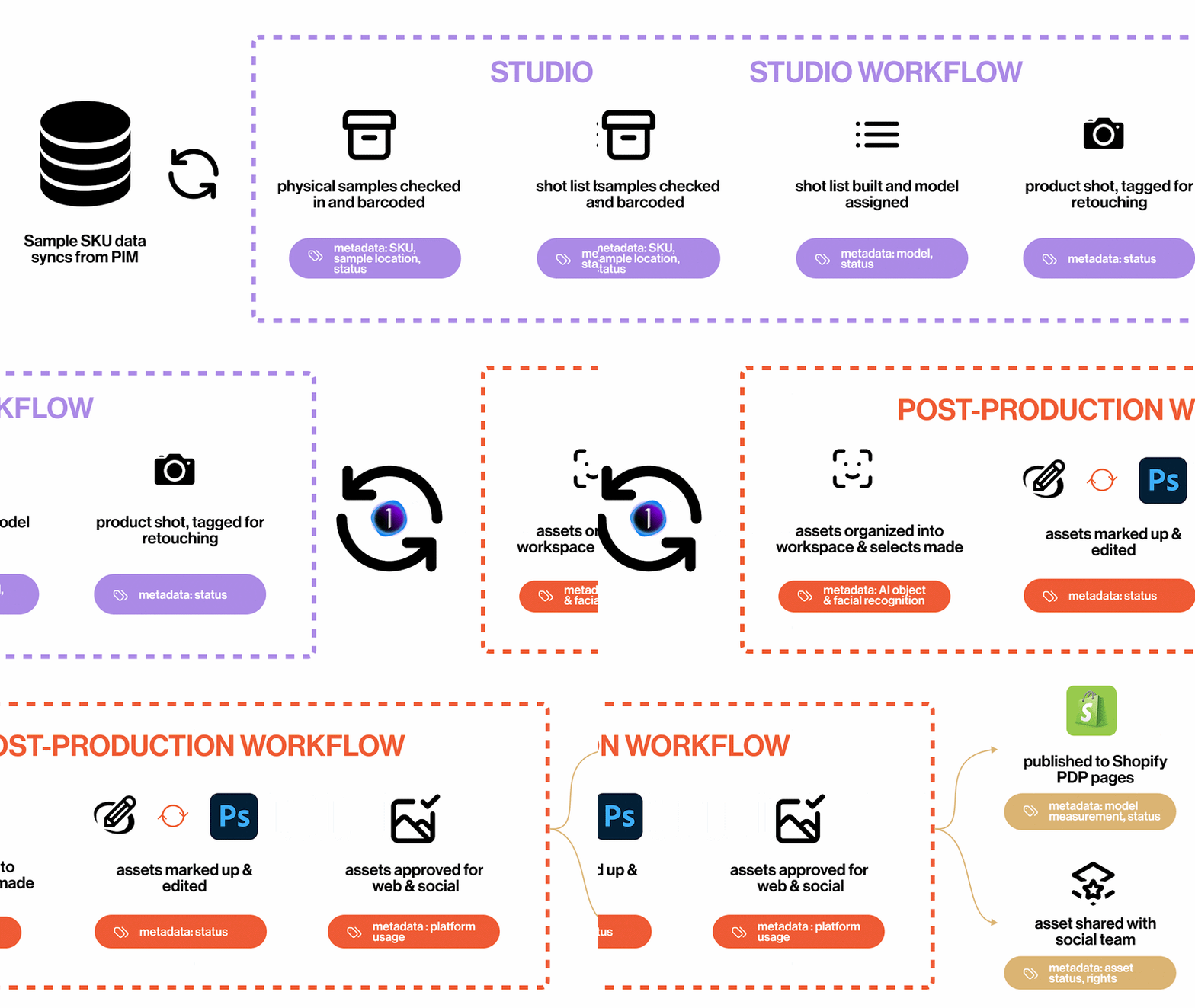
Modern creative workflows don’t end when an asset is marked as final. Assets move to e-commerce sites, social scheduling tools, campaign management systems, and beyond. When integrated with these platforms, crucial information like SKUs, image alt text, model measurements, and product dimensions travels with the file through metadata and populates automatically at their final destination, whether that’s an Airtable project, a Shopify PDP, or a YouTube playlist. Here, metadata eliminates the manual re-entry that introduces human error and slows down production.
Metadata management in practice: Globaledit is built for what’s next
Today, AI has become both the author and the reader: generative AI tools create and tag content, while agentic systems consume that information to route assets to the right channels, flag compliance risks, or populate downstream platforms. These tools are only as powerful as the context they’re given, so the quality of your metadata directly determines the quality of what they can do with it. Globaledit’s metadata capabilities are built for this moment: flexible to match the shifting needs of modern creative teams, scalable to keep pace with AI-driven content volume, and deeply integrated to power the connected workflows that are quickly becoming the industry standard.
Customizability
As AI transforms your team’s tech stack and internal workflows, your metadata schema should evolve with them. Globaledit supports fully custom metadata fields, so teams can capture exactly what’s relevant to their operation, whether that’s talent agreements and distribution rights, collections and shot types, or tools used and extent of AI involvement.
Scalability
Globaledit’s automated bulk metadata generation, retrieval, and updating capabilities ensure large libraries stay organized and searchable. Our AI-powered object and facial recognition features, including automatic identification of celebrity talent and trainable custom face models, tag assets accurately at ingestion, so nothing gets lost in your asset library, no matter how fast it grows.
Connectivity
Globaledit’s underlying integration infrastructure makes it simple to connect to your entire creative ecosystem and amplify the value of structured context that your metadata provides. These platform integrations turn metadata from a filing system into actionable information for everything from bi-directionally syncing statuses and automatically reflecting project updates in your PM platforms to auto-populating your CMS. We also follow EXIF, IPTC, and XMP standards that easily pass between multiple apps, so you can reap the benefits of Globaledit’s AI-generated metadata throughout all the connected tools in your workflow.
Strong metadata management has always made teams more organized. Today, it’s as relevant to creative, marketing, merchandising, and e-commerce teams as it is to digital technicians and digital asset managers; anyone whose work depends on finding, understanding, creating, and acting on content can do so faster and more easily because of it. When context matters more than ever and the appetite for content shows no signs of slowing, metadata management is the competitive advantage that positions brands to build workflows that are faster, smarter, and more powerful.