

Today we launched the Globaledit Brand Protection System, the industry’s first enterprise workflow system for content provenance and AI disclosure. Large brands have relied on a patchwork of point solutions that were not built for the scale, governance, and approvals of enterprise content operations. Globaledit brings provenance, disclosure, and compliance into one workflow teams can use every day. The first release, the Globaledit Provenance Suite, supports the C2PA (Coalition for Content Provenance and Authenticity) standard. It shows where each asset came from, how it may have changed, and how AI was involved.
No brand has an easy way to see how its content was made. Assets arrive from thousands of sources, including agencies, vendors, creators, and influencers, and AI can enter at any point along the way. That blind spot is now a legal exposure as well as an operational one.
The pressure is also coming from outside. AI tools have generated more than 15 billion images in about 18 months, roughly what photographers captured in the first 149 years of photography. Regulators are responding: the EU AI Act and California’s AI Transparency Act both took effect this year, with financial penalties for noncompliance. Brands, publishers, and agencies now have to prove where their images came from and how they were made, and they can’t do that without knowing what is in their content.
The Provenance Suite closes that gap. It gives brands a verifiable record of each asset’s history and the tools to act on it. Unverified and noncompliant AI content stays out of campaigns, and teams can keep publishing with confidence.
“Content becomes a liability when brands can’t see what is in it,” said Steve Kalalian, CEO of Globaledit. “Compliance depends on knowing an asset’s origin, and verification is how you get there. The Provenance Suite gives every user a clear view of an asset’s manifest, including its source and edit history, in a form that is easy to read and act on. That is how enterprise brands stay compliant and put AI to work.”
“All brands can face legal, compliance, and reputational risks associated with content authorship and distribution,” said Eli Kowalski, Director, Editorial Content Operations at Shutterstock. “It’s important to have a way to see where an asset came from, who created it, and how it’s been altered. Globaledit’s Provenance solution does that work so users don’t have to.”
“The conversation has moved from whether content authenticity will work to how to adopt it,” said Dan Dzuban, Vice Chair of C2PA and Head of Strategic Partners, Content Authenticity at Sony Electronics. “Verifiable provenance only works when every step in the chain, from capture to editing to asset management, supports it. Standards like C2PA Content Credentials help brands put that into practice.”
What the Globaledit Provenance Suite Does
The suite gives teams a clear summary of each asset:
- Identifies AI content: Reads and displays C2PA data from any tool. Many tools add this data automatically on export, including Adobe Firefly, ChatGPT and OpenAI, and certain Sony, Canon, and Google Pixel cameras.
- Maintains asset manifests: Keeps the C2PA data on upload and shows each asset’s origin and edit history, as both a full record and a summary. This includes real photos and videos that were altered with generative tools.
- Tags and filters by AI status: Teams can add AI involvement data to the asset card for an at-a-glance view and filter by status: AI Gen, AI Edit, AI None, or AI Unknown. Each step is marked Trusted, Valid, or Invalid.
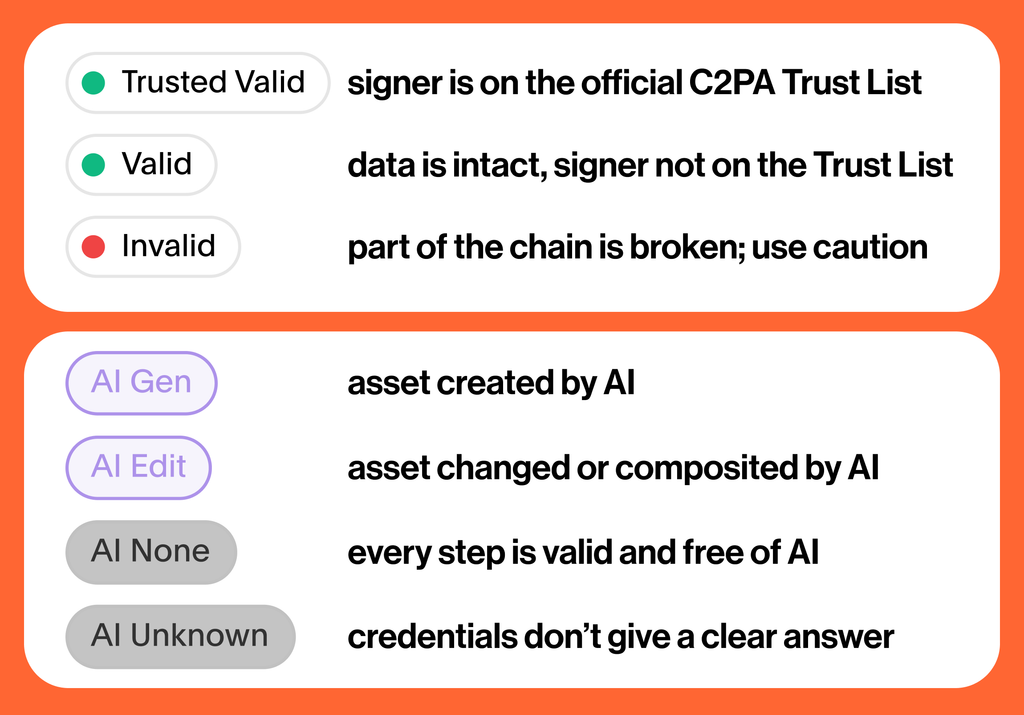
The Provenance Suite is the first release in the Globaledit Brand Protection System. More capabilities will follow in early 2027. Learn more and see it in action here.
Frequently Asked Questions
What is the Globaledit Brand Protection System?
The Globaledit Brand Protection System is a set of capabilities within the Globaledit platform that helps brands see, control, and comply with the content they produce. The first release is the Provenance Product Suite, with more to come in early 2027.
What is the Globaledit Provenance Suite?
It is the first release in the Brand Protection System. It reads C2PA Content Credentials, flags AI involvement, and shows each asset’s manifest, a verifiable record of where it came from and its life cycle as an asset.
How is the Globaledit Provenance Suite different from other approaches to AI disclosure and provenance?
Many provenance options are limited, complex, or sit outside the way teams work. Globaledit is built around workflow and real-world needs, so brands can get into compliance now, simply.
- Simple to use: C2PA data is read on upload and turned into a plain-language summary. No one has to decode raw manifest data.
- Built into the workflow: AI status shows on the asset card and can be filtered by AI Gen, AI Edit, AI None, or AI Unknown.
- Ready now: It works inside the platform teams already use, with no lengthy implementation.
Why do brands need to disclose AI-generated content?
Regulations such as the EU AI Act and California’s AI Transparency Act took effect this year, with financial penalties for noncompliance. Audiences also quickly spot low-effort AI content and tend to blame the brand that published it. Brands first need to know which of their assets involve AI.
How does the Globaledit Provenance Suite identify AI-generated content?
It reads and displays any C2PA data attached to an asset at upload, including data added by tools such as Adobe Firefly, ChatGPT and OpenAI, and certain Sony, Canon, and Google Pixel cameras.
What is C2PA, and how does the Globaledit Provenance Suite use it?
C2PA is an open standard that attaches tamper-evident Content Credentials to digital content, showing who made it, what was done to it, and whether AI was involved. The Globaledit platform supports the C2PA standard and turns its often technical manifest data into a readable history. Its steering committee includes Adobe, Amazon, Google, Meta, Microsoft, OpenAI, Sony, and TikTok.
What happens to assets without Content Credentials?
Assets that do not contain C2PA data will not show origin history. There will be no statuses applied to these assets.
Who is the Globaledit Provenance Suite built for?
The Globaledit Provenance Suite is built for creative, legal, and marketing teams at brands, publishers, and agencies that need to prove where their images came from and how they were made.
- Brand and marketing teams who need to know whether an asset involved AI before it goes into a campaign, ad, or retail placement, so they can make any necessary disclosures.
- Legal, compliance, and brand-safety reviewers who have to answer AI disclosure questions with evidence, not guesswork.
- Creative ops and admins who receive work from agencies, freelancers, or stock libraries and need a record of where it came from.